
Build your own high-value legal venture or consultancy, without starting from zero
A faster and more structured way to build your own niche legal business
A new path for ambitious lawyers
Most lawyers spend years building experience, but remain stuck in systems that limit their income, progression and control.
This is a fundamentally different model—designed for lawyers who want to create modern legal businesses of the future.
track record & reputation
Since launching in 2022
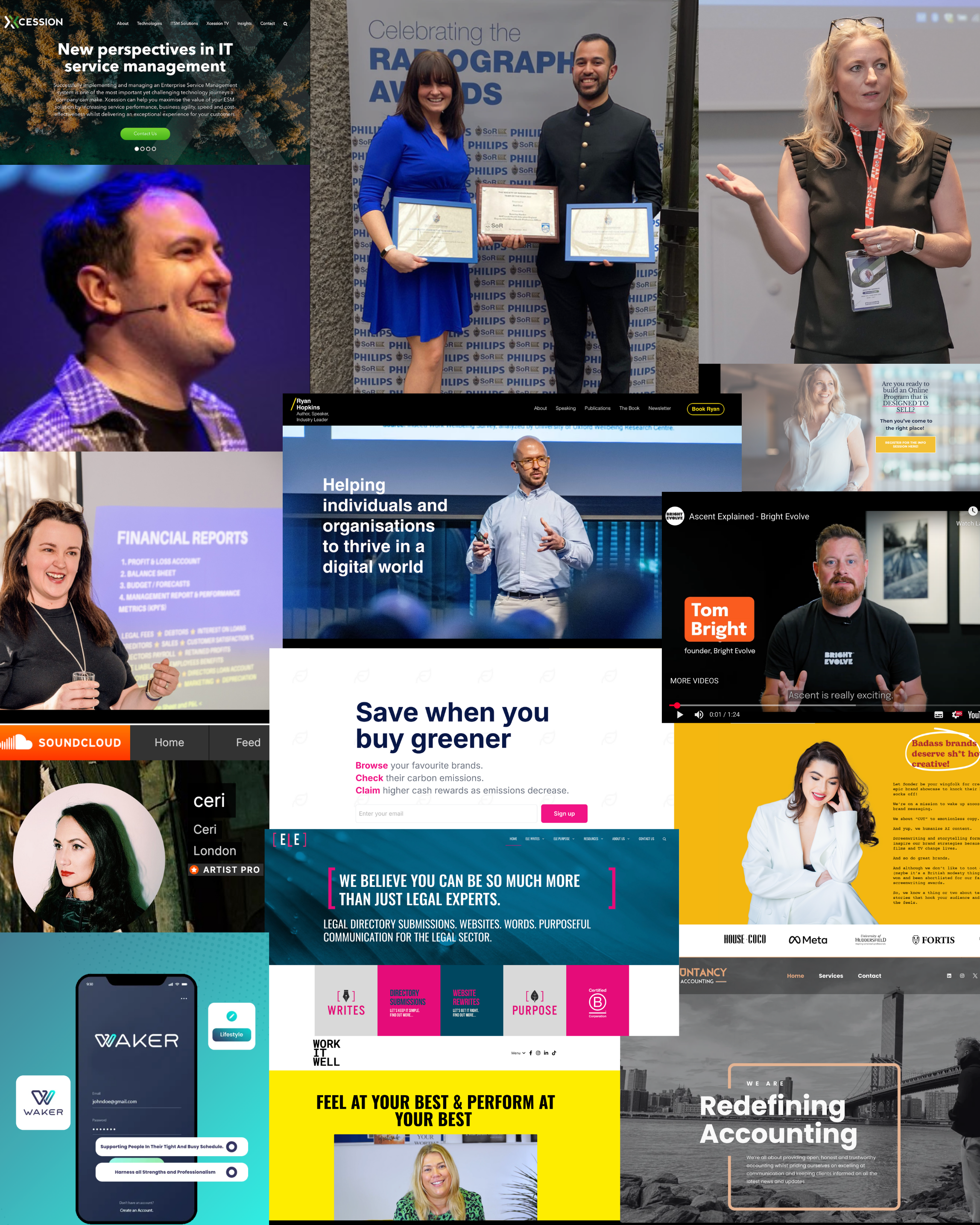
We've supported hundreds of new and established SMEs, consultancies and professionals—many award-winning—primarily in the tech, knowledge and professional sectors.
Our clients include businesses led by former professionals from organisations such as Amazon, Gartner, Revolut, EY, Meta and the NHS, as well as entrepreneurs who’ve taken alternative paths.
They operate nationally and internationally, working with clients ranging from small businesses to blue-chip companies, including BCG, Red Bull, OpenAI and PwC.
Trusted by directors across the UK & internationally, since 2022

New vs old legal
Many lawyers feel stuck in their current careers
– Slow progression
– Limited upside
– No real ownership
– Time-for-money
– Legacy structures
Even flexible consultancy platform models can be fickle
The market is shifting faster than ever before
– Changing client expectations
– Commoditisation
– Consolidation
– AI disruption
– Uncertainty
Standing still is now the biggest risk
The New Legal model is built for this shift
– Ownership and autonomy
– Multiple income streams
– A proven structure
– Future-proofing
– Collaboration
A seat at the table and a clear path to Equity Partner
A faster, more structured way to build your legal business
Starting your own legal brand can take years and significant investment
– No reputation
– No systems
– No foundations
By becoming a New Legal partner, you're ahead of the game from day one:
– Instant credibility
– Proven growth model
– Full business infrastructure
What that means for you
Step into a proven commercial model and a brand that's on the rise
You’re not starting from nothing. You’re stepping into:
– a trusted, rising brand
– a proven commercial model
– a network of clients and partners
So instead of spending years building credibility, you have it from day one.
And you can focus on building a valuable business—not just doing the work.
Areas of opportunity
Deals &
structuring
Help clients structure deals
Partnerships & joint ventures
M&A & exit planning
Equity & ownership
IP &
technology
Help clients protect & monetise IP
Technology & IP advice
IP licensing monetisation
Trade marks & brand protection
Growth &
operations
Help with support & contracts
On-demand legal counsel
Scalable legal infrastructure
Modern contracts
Global & cross-border
Help clients with global complexity
Cross-border deals & structuring
International IP strategy & licensing
Overseas customers, partners, teams
Disputes &
risk
Help clients stay safe
Disputes & separations
Misuse of IP & information
Contract exits
Talent &
teams
Empower clients' teams
Contractors & IR35
Employment & HR
Incentives & restrictions
How you can earn
Hourly
– Hourly: £65–£395/hour
– Bundles: bespoke
– Retainers: bespoke
Fixed & estimates
– Tier 1: £495–£990
– Tier 2: £1,237.50––£1,980
– Tier 3: £2,475––£4,970 +
Retainers
Develop retainers tailored to your clients, and earn recurring income
Training
Earn from training clients and your peers in the ecosystem
Partnerships
Access the new legal partner ecosystem to create win-win relationships
Subscriptions
Create your own unique subscription offers for ongoing legal support
How do I make money?
Three main ways:
Consultancy work you deliver
Legal work you originate (even if delivered by others)
Deals and opportunities (fees, revenue share, equity over time)
This allows you to move beyond pure delivery, and start building a business that generates income beyond your own time.
How much can I earn?
Each practice area or niche is designed to support a viable, scalable practice.
Your income depends on what you build—the clients you win, the rates you command, and how you structure your work.
We work with you to define a focus that can realistically support your income goals.
We support you to:
– build a strong client base
– refine your positioning and pricing
– increase your rates over time
– create multiple income streams
Some operators aim for £100K.
Others build towards £300K–£500K+ over time.
Your earnings will depend on how you balance:
– your time
– the work you originate
– and how you leverage the support, structure & systems provided
Can I earn from work I don’t personally deliver?
Yes.
If you originate work:
– you can participate commercially
– even if another person delivers it
This is a key difference from traditional models.
What you get
Profile &
positioning
Own your niche
– Your own niche and positioning
– Personal brand support
– Web profile on the New Legal site
Growth & business development
Get growing
– Marketing strategy and execution
– Sales and business development training & support
– Access to partnerships and opportunities
Infrastructure & operations
Operate professionally
– Company setup
– Operational support
– Systems, tools and processes
Tools &
assets
Access docs & tools
– Template bank
– Contracts, clauses & policies
– AI (quoting/drafting)
Legal & specialist support
Access lawyers to support you
– Access to junior, senior and specialist lawyers
– Support on complex matters
– Legal admin support
Your first year
Develop your foundations
Months 1–3
Define
– Define your niche
– Curate your network
– Build your pipeline
Months 4–6
Refine
– Refine your offerings
– Secure clients & partners
– Improve sales & marketing
Months 7–12
Build
– Double down
– Increase rates
– Ramp up earnings
Is a New Legal partnership right for you?
New Legal is for lawyers who are
(1) New solo consultants (3+ PQE or equivalent) who want to become legal business owners, and do something new and exciting with significant upside potential
(2) Already operating a small or solo consultancy practice and want to bring in new energy, resources and operational support to take your business to new heights under the New Legal brand
Who is this for
(1) Solo lawyer
You're aware of the opportunity to operate as a legal consultant but understand how hard it is to scale a practice on your own.
(2) Consultancy owner
You're already operating a practice and are overwhelmed or facing a plateau or decline and would like a safe pair of hands to help with growth, operations and delivery. We will work with you to develop your role – one that adds the most value – and this differs from person to person.
This could be for you if these apply:
– You want to move from delivery to ownership
– You're motivated by long-term value and stability
– You're ready to take responsibility for your own pipeline and growth
– You enjoy being client-facing
– You want to be involved in the business community
– You'd like to build your own practice
– Want more control and upside
– Enjoy working solo and with others
– You're willing to win work and build relationships
Who this is not for
This is probably not for you if these apply:
– You want to focus purely on technical delivery
– You’re uncomfortable with business development or visibility
– You expect a fully done-for-you pipeline
– You need a guaranteed salary from day one
– You’re not ready to take ownership of outcomes
We don't presently support: family, immigration, litigation, conveyancing law, or any reserved activities
Do I have the right experience?
We operate a unique collaboration model:
You can access senior or junior lawyers to support you
Whether that's for:
– a second opinion or sounding board
– sign-off on documents or advice
– assistance with your workload
Your peers at New Legal are here to support you at every level, at any time.
You're not just joining New Legal. You're securing your future, starting with trust and credibility today.
Ready to build your very own legal consultancy of the future?
Questions?
Frequently asked questions
What kind of lawyers is this for?
Typically:
– 2–8 PQE (or equivalent experience)
– commercially minded
– frustrated with traditional firms
– aware of shortfalls of consultancy platforms
– motivated to build something
More important than PQE is mindset:
– willing to build relationships
– willing to generate work
– want ownership and upside
Do I need to bring clients with me?
No, but you can.
You’ll have the opportunity (and support) to:
– build your own pipeline
– develop relationships
– generate opportunities
You’re supported with:
– business development
– personal brand
– marketing
– training
– systems
How do I make money?
Three main ways:
Consultancy work you deliver
Legal work you originate (even if delivered by others)
Deals and opportunities (fees, profit share, equity over time)
This is not just about billing your time.
Can I earn from work I don’t personally deliver?
Yes.
If you originate work:
– you can participate commercially
– even if another person delivers it
This is a key difference from traditional models.
What support do I get?
You’re supported with:
– personal brand and niche positioning
– marketing and content
– business development guidance
– training and playbooks
– access to partners
– specialist support across practice areas
– junior or senior support
We operate together.
What is the partnership track?
Typically:
Year 1: build your practice
Once you hit clear, agreed milestones: become Partner
Then, once further agreed milestones are hit, progress to Equity Partner
This is based on:
– performance
– pipeline
– commercial contribution
What makes this different from consultant platforms?
Consultant models give freedom—but often:
– no real support
– no growth engine
– limited upside beyond your own work
This model combines the best of all models:
– ownership
– autonomy with structure
– support
– partnership and equity pathway
Who provides me with legal support?
Junior and senior lawyers working with New Legal
– Some lawyers operate entirely by themselves
– Others need support from us to help with different elements of service delivery
– We provide the kind of support you need to operate your practice safely and profitably
– We provide support centrally and via partners
Is this right for me?
Who this is for
Lawyers who want to build their own practice.
– Want more control and upside
– Willing to win work and build relationships
– Think commercially
Who this is not for
– Anyone not willing to invest in themselves
– Anyone not willing to embrace change
– Looking for a salary from day one
– Want work handed to you
– Prefer not to do business development
Do I have the right experience?
We operate the unique sandwich model:
Seniors above. Juniors below.
Whether that's for:
– a second opinion or sounding board
– sign-off on documents or advice
– assistance with your workload
Your peers at New Legal are here to support you at every level, at any time.
Can I stay solo or do I need to grow my team?
You're welcome to do either.
The model allows for you to subcontract to your peers so you don't have to take on your own team.
As the workload increases your role will evolve and we can support with overflow and specialist work as needed.
Examples of how we help clients
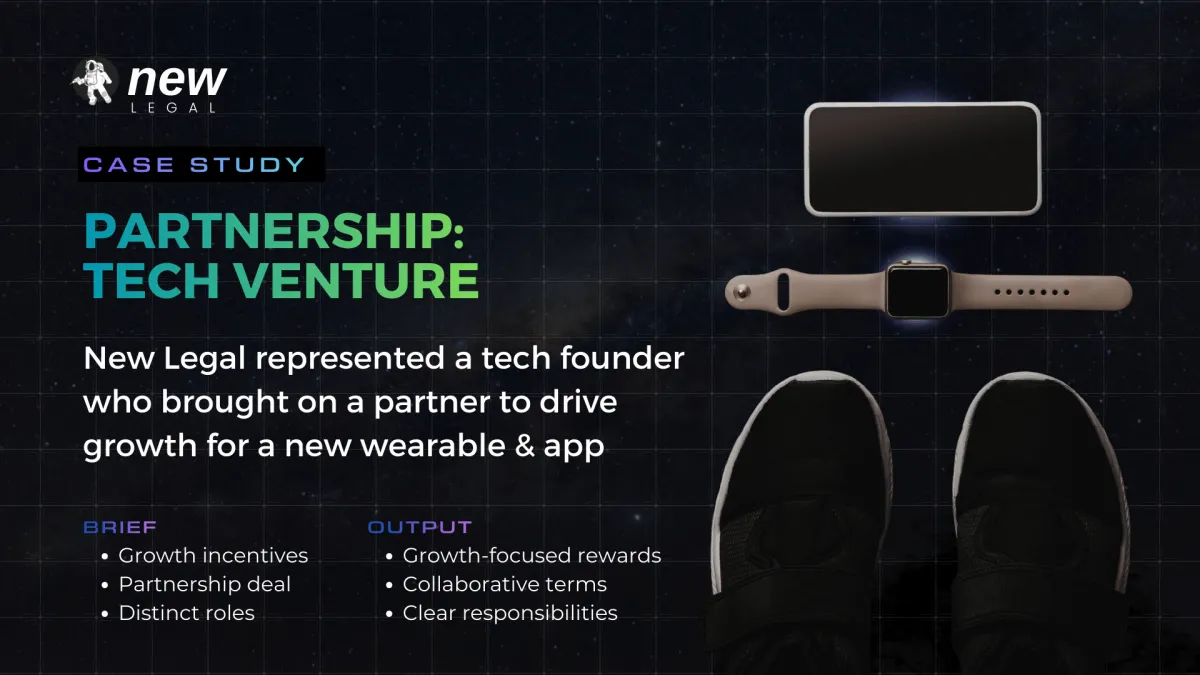
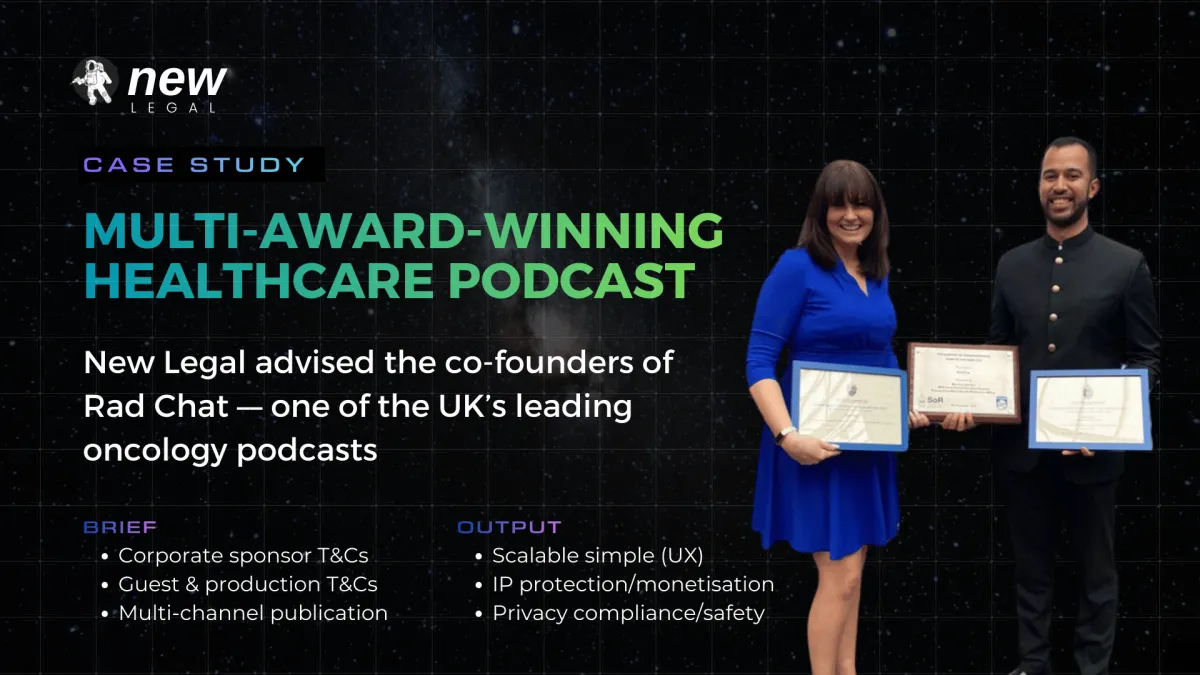
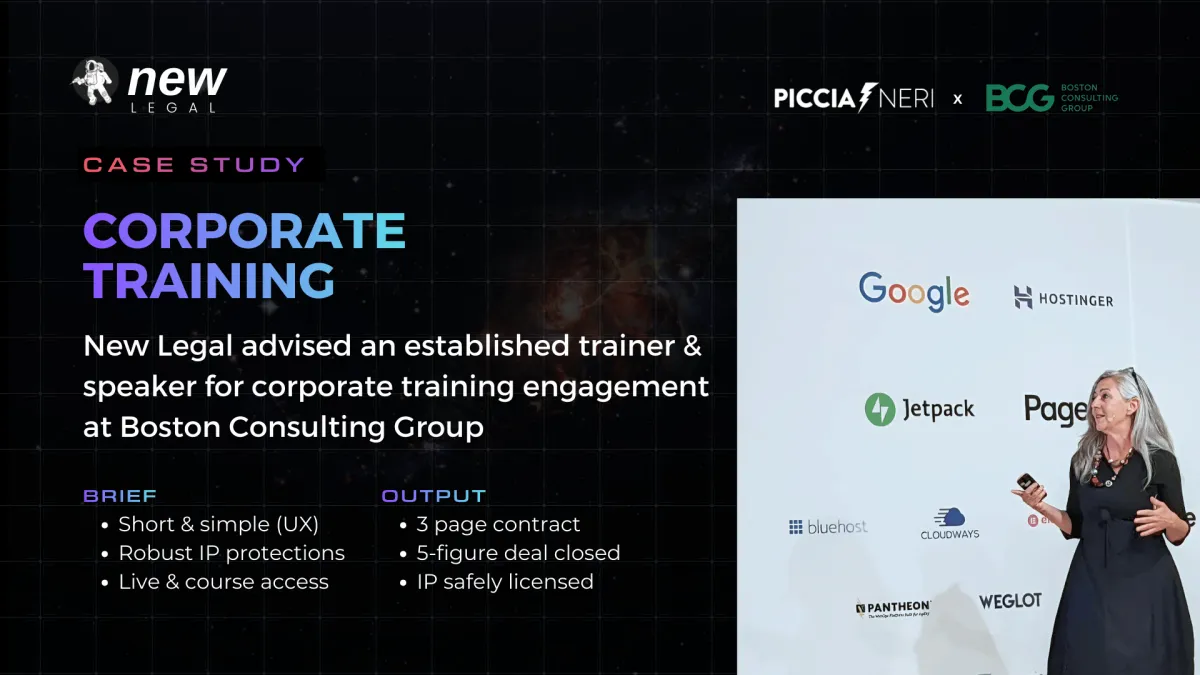
Case Studies
Often the work we do includes an element of commercial, IP, data and/or employment/HR

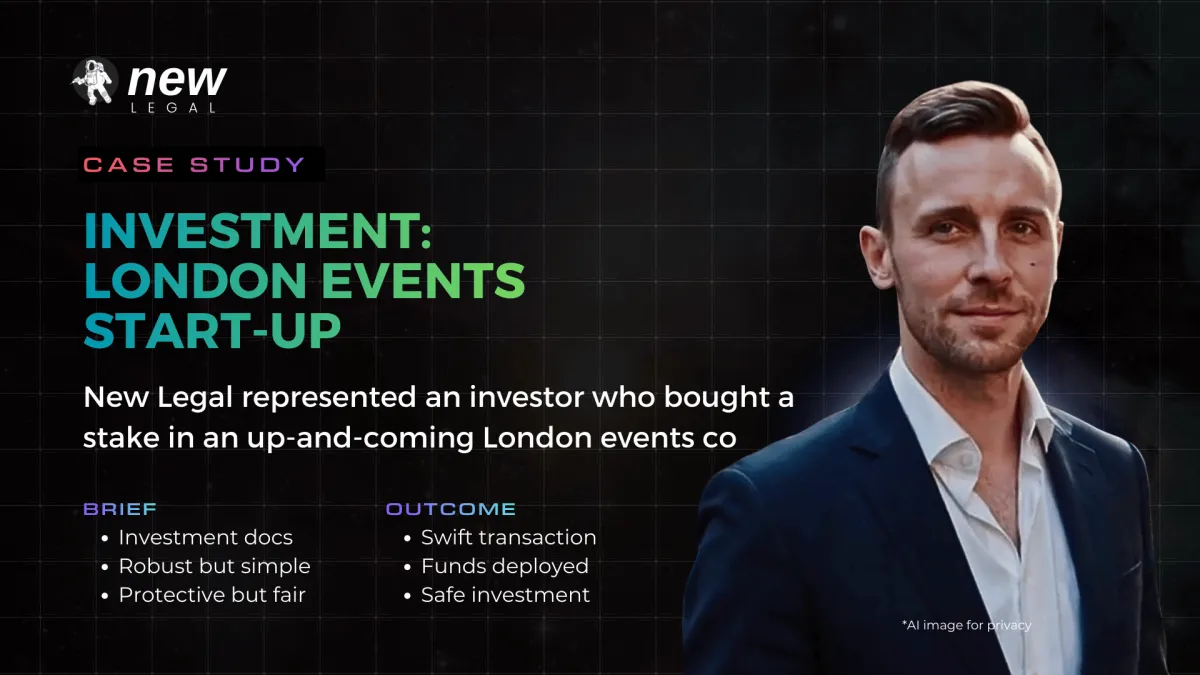

Case Study: Business Partnership Separation & IP Resolution
Case Study: Business Partnership Separation & IP Resolution
New Legal’s Dispute Resolution and Intellectual Property team advised a business owner on the breakdown and negotiated exit from a fast-moving business partnership involving licensed branding, intellectual property, digital assets and shared commercial relationships.
As the relationship deteriorated, disagreements over branding, ownership of IP, ownership of clients and accounts, ongoing restrictions and the client’s ability to trade independently created the risk of a wider commercial dispute.
Our team combined dispute resolution strategy with specialist IP input to contain the issues, negotiate a clean break and manage the subsequent rebrand and transition. The matter concluded without prolonged litigation, enabling the client to draw a line under the former relationship and move forward with a new independent business.
1. Strategic Objective
We advised the owner of a small business operating under a wider business partnership and licensed brand arrangement.
The relationship had deteriorated following disagreements around:
brand alignment;
performance expectations;
use of intellectual property;
ownership and control of digital assets;
customer and supplier relationships;
future competing activities.
What initially appeared capable of being managed through a commercial review developed into:
allegations of contractual breach;
threats of urgent legal action;
demands for immediate cessation of branding;
disputes over IP, content and business assets.
Commercial objective:
Contain the dispute.
Secure an accelerated but orderly exit.
Protect the client from continuing liabilities and restrictions.
Resolve IP and branding issues conclusively.
Allow the client to move forward with a new independent business.
2. Commercial Model
Existing arrangement
The client operated a regional business using:
licensed branding;
associated intellectual property;
established commercial processes;
relationships developed while operating under the partnership.
The arrangement also imposed continuing restrictions, including limitations on competing activity following termination.
Exit economics
Rather than allow the dispute to develop into expensive litigation, the strategy was to negotiate a mutually agreed commercial separation.
The client made practical concessions around:
timing of cessation;
rebranding;
remaining materials;
transition arrangements.
In return, the settlement was structured to achieve:
a mutual release of claims;
removal of continuing restrictions;
clarity around IP and branding;
finality between the parties.
Commercial implication:
The settlement converted an uncertain and potentially expensive dispute into a defined exit process.
The overall problems were contained within the client’s approximate anticipated legal budget.
3. Operational Exit
A key challenge was sequencing the exit correctly.
The other party wanted branding and cessation steps taken quickly.
However, the existing agreement remained legally operative until the settlement was completed.
Acting too early could therefore have exposed the client commercially while removing leverage.
We managed the transition so that:
settlement terms were agreed before irreversible steps were taken;
existing commitments could be handled appropriately;
branding could be withdrawn in an orderly manner;
remaining materials and administrative matters could be addressed;
the client could transition towards independent trading.
Interpretation:
The legal work was not simply about ending a contract.
It was about creating a controlled bridge between the old business relationship and the client’s next business.
4. IP, Branding & Digital Assets
IP became one of the central commercial issues.
The dispute touched on:
licensed brand names and branding;
photographs and other creative materials;
historic marketing content;
independently created digital accounts;
business goodwill and contacts;
existing stock and branded materials;
the distinction between partnership IP and assets created or controlled independently by the client.
We resisted attempts to treat every asset associated with the business as automatically belonging to the other party.
Key commercial point
A relationship may operate under another party’s brand without that necessarily determining ownership of:
independently created accounts;
independently generated content;
underlying relationships;
other separately owned business assets.
The settlement therefore focused on achieving practical separation of the IP position, rather than leaving ambiguous rights capable of generating future disputes.
5. Restrictions & Future Business
The original arrangement included restrictions affecting what the client could do after termination.
These became commercially significant because the client wanted to continue operating independently.
A core settlement objective was therefore to remove the relevant continuing restriction as part of the clean break.
Commercial purpose:
The client was not simply exiting an unsuccessful relationship.
The settlement needed to preserve her ability to move on and build a new business without the old arrangement continuing to constrain her.
That objective was achieved.
6. Post-Settlement IP Issues
Signing the settlement did not immediately end the practical risk.
During implementation, further allegations arose concerning:
historic online content;
residual branding;
communications with suppliers;
the description of the transition to a new trading name;
third-party perceptions of what had happened to the former business;
remaining handover arrangements.
We rapidly separated:
genuine practical clean-up items;
matters that could be resolved without admission;
disputed allegations;
wider reputational concerns.
Where residual branding or content could sensibly be addressed, it was dealt with promptly.
Where allegations went further than the agreed settlement position, the client’s rights were protected.
7. Communications & Reputation
One of the most important lessons from the matter was that IP separation is also a communications exercise.
Even after legal ownership and branding rights are addressed, suppliers and customers need to understand:
which business has ended;
which business continues;
whether there has been a transfer;
whether a new trading identity is independent.
The client's transition communication created scope for different interpretations, which led to further allegations.
We helped:
clarify the legal and commercial position;
neutralise potentially confusing messaging;
prevent unnecessary escalation;
manage correspondence with the former business partner;
reinforce the separation contemplated by the settlement.
Key insight:
Technically accurate communications can still create commercial risk if their implication or framing is unclear.
8. Risk Protection & Resolution
The approach throughout was de-escalation without unnecessary concession.
We:
preserved the client’s contractual position;
avoided responding disproportionately to every allegation;
used protected settlement negotiations to narrow the dispute;
retained control over settlement drafting and execution;
secured a mutual release and clean break;
addressed IP and branding issues practically;
managed further issues arising during implementation;
sought to prevent post-settlement communications becoming a new dispute.
This avoided the relationship developing into a prolonged cycle of claims, counterclaims and potentially urgent court proceedings.
9. Outcome
Settlement successfully concluded.
Existing business relationship terminated.
Licensed branding ceased.
IP and digital issues contained and resolved.
Continuing competitive restrictions removed as part of the settlement.
Remaining transition issues managed following execution.
No prolonged litigation was required.
Overall dispute remained within the client's approximate anticipated legal spend.
Most importantly, the client was able to draw a line under the former relationship and move forward with a new independent business.
Strategic Takeaway
Containment over confrontation: the dispute was prevented from becoming disproportionate to the underlying business.
IP was central: branding, content and digital assets required careful separation rather than assumptions based on historic use.
Sequence mattered: settlement needed to be secured before the client surrendered commercially important rights or leverage.
Implementation mattered: signing was only part of the solution; post-settlement branding and communications required active management.
Commercial outcome: the client obtained finality, freedom from the old relationship and a practical route into her next business venture.


MEET THE FOUNDER
Hey, I'm Ian!
I'm on a mission to ensure that the risk-takers and innovators of the world have the right legal support and contracts to keep them out of harm's way so that they can prosper.
I've seen too many people face the devastating consequences of business when things go wrong – it's damaging to individuals and society.
We're doing our bit to improve business success rates by offering high-quality accessible legal solutions globally, powered by tech and supported by leading legal professionals.
WHAT WE'RE ALL ABOUT:
Simple & scalable legal solutions for modern businesses
Impacting society by supporting risk-takers & innovators
Boosting social mobility & economic empowerment
COMPANY
CUSTOMER CARE
LEGAL


*T&Cs apply. N3WWW LTD (trading as 'New' & 'New Legal'), part of the New Legal Group, is a limited company registered in England & Wales (no. 13889459), VAT registration number 515944772, registered office Suite 169, 23 King Street, Cambridge, CB1 1AH. New Legal is a legal consultancy, not a law firm, and is not authorised and regulated by the Solicitors Regulation Authority. New is a business business consultancy and infrastructure platform. We do not provide regulated accountancy or audit services ourselves. Accountancy, bookkeeping and tax services are delivered by our third-party partners. New is not an insurance broker or FCA-regulated insurance intermediary. English law only. Sponsorship, promotions and credits apply to selected products, services and tiers only – T&Cs and eligibility apply. Subject to availability. Products & Services are provided subject to our Terms of Service, and your data is processed as per our our Privacy Notice (including our data protection complaints policy), available here: https://new-legal.com/legal