
Advising directors on IP, equity, business partnerships & separations
Legal, IP & deal-making advisory for tech directors & consultants
Trusted by directors across the UK & internationally, since 2022





The decisions directors take carry real commercial consequences
We take the pressure off by de-risking critical deals and legal documents to protect relationships, reputation & long-term value
NEW legal
Since launching in 2022
We’ve supported hundreds of new and established SMEs, consultancies and professionals—many award-winning—primarily in the tech, knowledge and professional sectors.
Our clients include businesses led by former professionals from organisations such as Amazon, Gartner, Revolut, EY, Meta and the NHS, as well as entrepreneurs who’ve taken alternative paths.
They operate nationally and internationally, working with clients ranging from small businesses to blue-chip companies, including BCG, Red Bull, OpenAI and PwC.
Why clients keep us on speed dial
Not a traditional law firm
–– by design
– Senior lawyers & deal-makers
– Direct access (no gatekeepers)
– Fast, responsive support
– Transparent, predictable pricing
– Clear, pragmatic advice, not theory
Corporations have legal teams –– we’re yours
– Deals & structures that survive turbulence
– Avoid costly mistakes & disputes
– More value from business/IP deals
– More time & bandwidth for growth
– Protected reputation & relationships
Explore how we support you
Deals &
structuring
Structure deals on the right terms
Partnerships & joint ventures
M&A & exit planning
Equity & ownership
IP &
technology
Protect & monetise your IP
Technology & IP advice
IP licensing
IP monetisation
Growth &
operations
Scalable legal support & contracts
On-demand legal counsel
Scalable legal infrastructure
Modern contracts
Global & cross-border
Navigate global complexity
Cross-border deals & structuring
International IP strategy & licensing
Overseas customers, partners, teams
Disputes &
risk
Contain issues & protect assets
Disputes & separations
Misuse of IP & information
Contract exits
Talent &
teams
Align talent with your ambitions
Contractors , creators & IR35
Employment & HR
Incentives & restrictions
Case Studies

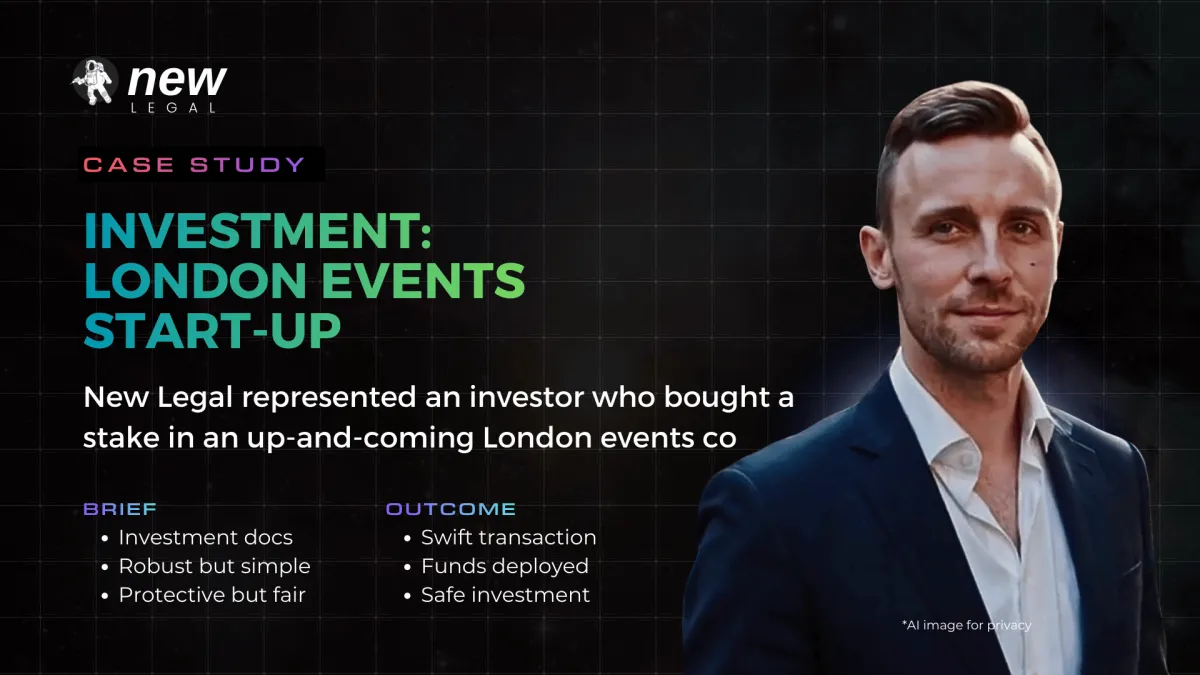


Case Study: Founders' Agreement (90/10) for a Global Tech Platform Start-Up
This case study analyses an interim founders' agreement for a global tech platform start-up, focusing on how equity, control, incentives, and downside protection are structured at an early stage.
The agreement is designed to balance:
asymmetric founder contribution at inception
future commitment uncertainty
protection against early departure
long-term IP consolidation within the company
It combines vesting, dynamic equity adjustment, and strong leaver mechanics to manage risk while preserving upside alignment.
Gap Analysis (Pre-Agreement Risk)
Before this agreement, the structure would likely create material founder misalignment and downside exposure, particularly given the unequal contribution levels and initial 90:10 ownership. Care was needed to manage allocation of equity to a part-time or uncertain contributor, with no mechanism to adjust ownership if commitment never materialises. This creates a classic early-stage failure mode where one founder carries execution while the other retains disproportionate upside, leading to resentment, stalled decision-making, and difficulty raising capital due to an “unclean” cap table. There would also be no protection against early departure, meaning a founder could leave with meaningful equity despite limited contribution, creating long-term dead equity and governance friction.
Additionally, without formalised vesting, IP assignment, and leaver provisions, the business would face serious structural and investor risks. Intellectual property might remain fragmented or personally owned, undermining acquisition or fundraising readiness. There would be no clear mechanism to reclaim equity or enforce accountability, exposing the company to free-rider problems and potential disputes. Governance would also be weak, with no defined control rights, casting vote, or reserved matters framework—making deadlock highly likely. Overall, the pre-agreement state would be high-risk, informal, and misaligned with venture-scale expectations.
Resulting Structure (Post-Agreement Outcome)
Post-agreement, the structure introduces tight alignment between ownership, contribution, and control, significantly reducing early-stage founder risk. Equity is no longer static—it becomes conditional, time-based, and performance-linked, particularly through vesting and the full-time trigger. This ensures that the minority founder’s ownership scales only if commitment increases, while the majority founder is protected from premature dilution. The inclusion of early exit economics (75/25 override) further reinforces this logic by aligning payout with actual contribution during the most fragile phase of the company. As a result, the cap table remains clean, defensible, and investor-ready.
The agreement also creates a robust institutional foundation for scaling, consolidating all IP within the company and introducing clear governance, control, and dispute mechanisms. Strong leaver provisions eliminate dead equity risk and enforce accountability, while operational and reporting structures ensure ongoing engagement. Control is clearly centralised (via majority ownership and casting vote), avoiding early deadlock while still preserving minority participation. Overall, the post-agreement structure transforms the business into a controlled, scalable, and investment-grade entity, with clear incentives, protections, and long-term value capture mechanisms in place.
Case Study: Dynamic Founder Equity & Control Structure
1. Strategic Objective
The agreement is designed to:
formalise an imbalanced starting contribution (one original founder, one supporting founder)
create a pathway for future equity rebalancing based on commitment
protect the business from early-stage founder drop-off risk
ensure all value (especially IP) accrues to the company
Interpretation:
This structure treats one founder as the core operator, and the other as a conditional long-term partner whose ownership scales with commitment.
2. Commercial Model
1. Initial equity split
Founder A: ~90%
Founder B: ~10%
Implication:
Reflects pre-existing work, risk, and control
Establishes clear decision-making hierarchy from day one
2. Vesting structure
50% vests immediately
50% vests monthly over 4 years
Implication:
Rewards past work
Enforces long-term retention and contribution
Standard startup vesting, but with high upfront recognition
3. Conditional equity uplift (key feature)
If Founder B goes full-time:
Within ~6 months → increases to ~33%
Within ~12 months → increases to ~25%
Implication:
Equity is earned through commitment, not promised upfront
Creates a time-based incentive to join early
Protects majority founder from premature dilution
4. Early exit economics
If company sells within ~12 months:
~75% proceeds to Founder A
~25% to Founder B
All shares accelerate to full vesting
Implication:
Overrides cap table to reflect true contribution at early stage
Prevents windfall gains from short-term passive involvement
3. Operational Engine / Deliverables
Founder roles
Founder A: Managing Director (full operational control)
Founder B: Advisor (initially part-time)
Key operational expectations
Monthly reporting and updates
Regular strategy meetings (bi-monthly + quarterly deep dives)
Shared responsibility for growth and operations
Infrastructure
Accounting outsourced early
Compliance, insurance, and legal handled proactively
Interpretation:
Founder A = execution engine
Founder B = strategic support with optional escalation to operator
4. Ownership / Rights Structure
IP ownership
All business-related IP assigned to the company
Applies to:
pre-incorporation work
ongoing developments
Founder personal brand/IP excluded but:
licensed to company (revocable, ~180 days notice)
Key commercial point:
The company owns all scalable value (IP, product, systems)
Implication:
Enables:
future fundraising
clean acquisitions
cross-market expansion (e.g. UAE subsidiary)
Equity mechanics
Only vested shares carry voting rights
Unvested shares are at risk on exit
5. Exclusivity / Restrictions
Non-solicitation
~6 months post-exit restriction on clients
Non-poaching
~12 months restriction on team/suppliers
Business activity
Founders can pursue other ventures
Must avoid conflicts with company
Commercial purpose:
Protects:
early customer base
team stability
operational continuity
6. Governance / Control
Voting control
Voting aligned with shareholding
Founder A has casting vote during early phase
Board structure
Both founders can be directors
Founder A acts as chairman
Reserved matters
Key decisions require ~75% shareholder approval, including:
major transactions (~£20k+)
fundraising / dilution
structural changes
Interpretation:
Founder A retains effective control
Minority founder has limited blocking power
7. Risk Protection
Leaver framework (highly structured)
Three categories:
Good Leaver → fair value
Bad Leaver → discounted (~10–20%)
Horrible Leaver → nominal value
Unvested shares
Always forfeited on exit
Transferred at nominal value
Additional protections
IP assignment warranties
confidentiality obligations
misconduct and reputation clauses
Implication:
Strong deterrent against:
early departure
underperformance
misconduct
8. Termination Structure
Exit triggers
Voluntary departure
breach / misconduct
incapacity
mutual agreement
Share sale mechanics
Shares first offered to remaining founder
Company can buy if founder declines
Payment can be staged (~180 days)
Dispute resolution
Structured escalation:
internal discussion
independent third party
mediation (CEDR)
courts (UK)
Commercial implication:
Ensures orderly founder exit without destabilising the company
9. Strategic Takeaway
The deal combines:
heavily asymmetric initial ownership
performance-based equity scaling
strict vesting and clawback protections
Founder B’s upside is:
earned through commitment
time-sensitive (early join incentive)
Founder A retains:
control
downside protection
economic priority in early exit
IP structure ensures:
all long-term value sits at company level
Result:
This is a founder-first control structure with conditional partnership upside, turning the second founder into a probationary co-founder whose equity scales with execution and commitment.
Pricing
Option 1 — Lean / Early-Stage Setup (Template Founders' Agreement + Light Tailoring)
💡 Best for:
Pre-revenue or testing phase
You want protection but not over-invest yet
What you’d include:
Founders’/shareholders’ agreement (light structure)
Basic vesting clause
Simple IP assignment
Light leaver provisions
Pricing:
Around £990 (ex VAT)
👉 This would simplify:
Dynamic equity uplift (may be basic or manual)
Early exit economics (likely less customised)
Option 2 — Growth-Ready (Mid-Level Tailored) – Founders' or Shareholder's Agreement
💡 Best for:
You’re serious about building this
Some complexity (like your conditional equity + vesting)
Want to avoid redoing everything in 6–12 months
What you’d include:
Proper vesting schedule (time-based + structure)
Conditional equity mechanics (your 10% → 25–33%)
Defined roles (operator vs advisor)
Structured leaver framework
IP assignment + licensing (important in your case)
Pricing:
£1,237 – £1,980 (ex VAT)
👉 This is often the sweet spot for setups like yours if:
risk is moderate
founders are aligned
Option 3 — Full Strategic Setup (Complete) – Shareholder's Agreement & associated
💡 Best for:
You want this to hold up under pressure
Asymmetric founders (like your 90/10 split)
Complex incentives + downside protection
What you’d include:
Dynamic equity adjustment (time + commitment-based)
Advanced vesting + acceleration logic
Custom early exit waterfall (75/25 override)
Multi-tier leaver framework (good / bad / horrible)
Detailed governance + control (casting vote, thresholds)
IP structure (assignment + licensing of personal brand)
Transfer + buyback mechanics (staged payments, etc.)
Pricing:
£2,475 – £4,970+ (ex VAT)
👉 Based on your case study, this is the closest match
(because of the dynamic equity + layered protections)
➕ Optional add-ons (often relevant here)
NDA (protect early discussions) → £99 – £195
Contractor/subcontractor agreements → £99 – £495
Preliminary compliance or structuring input → £297 – £495
Simple decision guide
If this is experimental → go Light
If this is serious but evolving → go Mid
If this is high-stakes or long-term → go Complete ✅
⚠️ Important
This is indicative pricing only (not legal advice)
Final scope depends on:
how detailed the equity mechanics are
how much negotiation/customisation is needed
🚀 Next step (recommended)
Best move is to:
Copy your preferred option
Get it confirmed properly
👉 Book a free 15–30 min call: https://new-legal.com/



"Best investment this year"
"Best investment this year – and one that I will use many times over. Highly recommended."
Piccia Neri
Founder, Piccia Neri

"Easy to implement"
"I wanted a straightforward approach, tailored to my business, easy to implement. Ian delivered on every aspect."
Tom Bright
Founder, Bright Evolve

"Breath of fresh air"
"We've been so happy with our terms of business we've now moved on to redoing our employment contracts and subcontractor agreements."
Helen Foord
CEO, ELE Global
Your mission partners
Advisors passionate about business, people & IP

Josh Smith
MA/LPC, BSc (Hons), GDL
Senior Legal & Business Consultant
– Corporate/equity
– Business Partnerships
– Commercial
– Finance
– IP
Josh qualified as a solicitor at Travers Smith, a prestigious London Silver Circle law firm.
10+ years of experience in corporate, commercial and finance – within private practice and in-house (UK and UAE).

Daniel McAfee
LLB (Hons)
Senior Legal Disputes Consultant
– Dispute Resolution
– Business Partnerships & Separations
– Contract Breaches
Daniel is a dispute resolution solicitor with 10+ years' litigation and legal operations experience across private practice and high-growth business.
He was the founding legal hire and Legal Director at Lawhive, helping scale the UK's first AI-native law firm through three funding rounds to a $685m valuation.

Laurence Winsby
LLB (Hons)
Legal & IP Consultant
– Contracts
– IP
– Dispute Resolution
– Data/AI
Laurence is a commercially aware legal consultant with training across multiple areas of law and experience in risk and compliance developed at a Top 100 UK Law Firm.
Previously a Governance and Risk professional, Laurence has specialisms in Data Protection, Anti Money Laundering, Claims, Complaints and professional regulatory compliance.
Trained as a civil and commercial mediator, Laurence is experienced in resolving disputes.
Laurence is entrepreneurial, building and launching a suite of legal technology products for lawyers and professionals.

Indy Sira
LPC, MSc & LLB (Hons)
Senior Legal & IP Consultant
– IP
– Digital media
– Commercial
– Technology
– Data/AI
– Talent & employment
Indy is a commercial, IP and digital media lawyer with over 10 years’ experience working inside fast moving businesses.
She advises founders, agencies and growth stage companies on commercial contracts, IP, advertising, data privacy, regulatory and digital risk, with a particular focus on where content, intellectual property and technology intersect particularly across media, talent, gaming, AI and the creator economy.
Having held senior legal roles at ITV Studios, Footballco, PA Media and Rakuten Advertising, Indy brings the kind of legal support businesses actually need: clear, commercial and built around how deals, teams and clients work in practice.

Luke Beckly
BSc (Hons), CIPP/E, CIPM, Certified EU GDPR Practitioner
Senior Data Protection Compliance Consultant
– Data Protection
– Privacy & Governance
– Data & AI Strategy
Luke is a highly experienced data and privacy leader with 30+ years in data architecture, analytics, and governance.
Previously DPO & Head of Privacy and Data Governance at Correla, and senior roles at British Land, Virgin Media, and the EBRD.
Founder of DC Harmonised and co-founder of EnsoFlow, CTRL//SHIFT AI, and Uncharted Summits.
Recognised speaker and advocate in data governance and privacy, helping organisations unlock value from data while building trust and maintaining compliance.

Grace Pariser
CIPD Level 7, MA HRM
Senior HR & Employment Law Consultant
– Employment Law
– Complex Workplace Issues
– TUPE
– Settlement Agreements
– Bespoke Document Drafting
Grace has spent over nine years working in HR, helping employers handle the situations that keep business owners up at night, from disciplinaries and redundancies to contract disputes and settlement agreements.
She works directly with business owners who don't have in-house HR support, giving practical, plain-English advice and bespoke documents built around their business.

Ian Greig MBA
MBA, BSc (Hons), GDL
Director & Legal & Business Consultant
– Business Partnerships
– Commercial
– IP
– Privacy
– AI
Ian is an experienced entrepreneur, company director and legal professional.
For 10+ years he has worked in director roles at start-ups and scale-ups, and has advised hundreds of successful businesses and brands.

Laura Williamson
FInstLM, Chartered MCIPD, ACILEx
Senior Employment/HR Consultant
– Employment
– HR
– Talent
Laura is an award-winning experienced and qualified HR director and employment lawyer.
Previously a director of a medium-sized accountancy practice, and has 15+ years of HR experience.
Winner of the HRi Awards 2023 (Emerging Talent).
Winner of the SME News Legal Awards 2024 (Best International Employment Law Services & Training Consultancy 2024).
Winner of the SME News Legal Awards 2024 (UK Legal Client Service Excellence Award 2024).

MEET THE FOUNDER
Hey, I'm Ian!
I'm on a mission to ensure that the risk-takers and innovators of the world have the right legal support and contracts to keep them out of harm's way so that they can prosper.
I've seen too many people face the devastating consequences of business when things go wrong – it's damaging to individuals and society.
We're doing our bit to improve business success rates by offering high-quality accessible legal solutions globally, powered by tech and supported by leading legal professionals.
WHAT WE'RE ALL ABOUT:
Simple & scalable legal solutions for modern businesses
Impacting society by supporting risk-takers & innovators
Boosting social mobility & economic empowerment
COMPANY
CUSTOMER CARE
LEGAL


*T&Cs apply. N3WWW LTD (trading as 'New' & 'New Legal'), part of the New Legal Group, is a limited company registered in England & Wales (no. 13889459), VAT registration number 515944772, registered office Suite 169, 23 King Street, Cambridge, CB1 1AH. New Legal is a legal consultancy, not a law firm, and is not authorised and regulated by the Solicitors Regulation Authority. New is a business business consultancy and infrastructure platform. We do not provide regulated accountancy or audit services ourselves. Accountancy, bookkeeping and tax services are delivered by our third-party partners. New is not an insurance broker or FCA-regulated insurance intermediary. English law only. Sponsorship, promotions and credits apply to selected products, services and tiers only – T&Cs and eligibility apply. Subject to availability. Products & Services are provided subject to our Terms of Service, and your data is processed as per our our Privacy Notice (including our data protection complaints policy), available here: https://new-legal.com/legal